Health is all about eating well and it is in this blog that I get into the details of why certain foods test poorly during a muscle testing appointment. The top 2 foods that most people have to stay away from for a period of time to help the body heal is sugar and wheat.
When you eat too much sugar it can cause depression, it can cause you to store sugar as fat instead of using it for energy. It can cause you to have highs and lows in your energy, and it can lead to diabetes. Sugar makes you gain weight, and feel tired. Eating fat doesn’t make you overweight, sugar does. Eating too much sugar and carbs is the reason that most people are tired all the time as well. Not to mention that sugar zaps the collagen in your skin, and dulls your complexion. There is no nutritional value to white refined sugar, which most of it now comes from genetically modified beets, or white sugar from sugar cane which is now labeled as cane sugar or evaporated cane juice. There is very little nutritional value in real brown sugar because the molasses holds some nutritional value but not much. Brown sugar really is just one step away from being white sugar. The molasses content is 3.5% molasses (light brown sugar) to 6.5% molasses (dark brown sugar).
When it comes to wheat sometimes patients have to stay away from wheat but other times they have to stay away from gluten. Gluten is a protein found in grains including wheat but gluten is also in oat, spelt, rye, and barley and some people have a true allergy to it where their body cannot digest it so when consumed, their digestive track becomes inflamed, the intestinal wall gets damaged and over time celiac disease forms. Celiac disease is diagnosed by blood tests and examining a small piece of tissue from your intestinal track to see if it's damaged.
But a lot of people who feel that gluten may be an issue for them go for the celiac disease test and it comes back negative, yet they know they somehow feel better if they don't eat gluten. So even though there is no true gluten allergy causing a disease there could be a gluten sensitivity causing symptoms. That is why I muscle test to see if gluten is a problem for the body to digest and once off gluten their symptoms become better. Symptoms helped by not eating gluten when indicated by the muscle testing include acne, constipation, diarrhea, gas, acid reflux, headaches. A lot of the times patients inform me about weight loss that occurs as a result as well.
Sometimes though, when testing the body, I don't find gluten as a problem for the body to digest but wheat itself is a problem. Whereas the other grains, oat, rye, spelt, and barley are okay for a patient to eat. So why would wheat be an issue but not gluten? The answer is because wheat has been genetically modified and the body looks at it as a toxin instead of a food. So for some bodies it is a "perfect, chronic poison," according to Dr. William Davis, a cardiologist who has published Wheat Belly. Davis said that the wheat we eat these days isn't the wheat your grandma had: "It's an 18-inch tall plant created by genetic research in the '60s and '70s." This thing has many new features nobody told you about, such as there's a new protein in this thing called gliadin. It's not gluten. The gliadin protein is an opiate. This thing binds into the opiate receptors in your brain and in most people stimulates appetite. Opiates include chemicals like morphine, heroin and opium. So this genetically modified wheat is addicting and not easy to get off of without some determination.
The original wheat plant is averages 48 inches and also has less gluten in it. So this new genetically modified American wheat is shorter, with up to 3 times more gluten in it and a new protein, gliadin in it that makes it addictive. Genetically modified wheat is not a food but a poison. This is why the ‘gluten-free’ trend is not a trend but a healthy lifestyle that is here to stay since they changed the plant 50 years ago.
When I talk about staying away from wheat I include white flour in that as well because white flour comes from the wheat plant but when it is made in the mill it is bleached with chlorine. That is the difference between wheat and white flour, bleach, which we would never drink in a million years but is in our food. When buying wheat look for ‘unbleached flour’. If it just says flour then assume it is bleached.
My patients and I notice when we go to Europe and we eat the wheat there it doesn’t make us feel bad and that is because Europe’s wheat is not genetically modified, and our body knows how to digest it and use it as food. it is illegal to bleach it too in Europe. Instead it is the millers’ job to separate the heat bran, wheat germ and pure white flour in order to get the unbleached white flour. One of my really good friends is Italian, living in Paris, and explains to me that they purposely stay away from American food with wheat or white flour in it because they know it doesn’t make them feel good. They call it ‘American wheat’ and they purposely go out of their way not to buy it.
So when people stop eating wheat, just like when people stop eating gluten, they tend to lose weight. My patients have also found relief in digestive issues, fatigue, headaches, acne, severe PMS and brain fog when not eating wheat. When making food options while staying off of wheat you know if it's gluten-free then it won't have wheat so buying/ordering gluten-free is an easy way to go about cleaning up the wheat in your diet.
Besides staying off of the bread, pasta, bagels, pretzels which are obvious white flour/gluten containing foods one should be careful of gravies, soups and salad dressings which tend to use wheat as a thickener. Soy sauce has gluten in it as well and so a lot of my patients go to a health food store and get gluten-free soy sauce and bring that to the restaurant when ordering sushi or sashimi.

There is something called ‘sprouted wheat” which we test as a different food than wheat or gluten. When wheat is sprouted it keeps many of it’s nutrients. Other grains such as oats, rye, rice, and quinoa can also be sprouted and are healthier for you compared to regular grains. Refined, processed grains are stripped of most of their nutrients, as the bran and the germ of the grain are removed. When making white flour, most of the vitamins B1, B2, B3, E, folic acid, calcium, zinc, iron, and fiber are lost leaving you with a useless starchy food that has a host of negative health consequences.
Eating refined grains can directly contribute to obesity, high cholesterol, heart disease, stroke, and diabetes. This is why sprouting your grains or buying them sprouted is so important. As much as 5x more nutrients are found in sprouted grains compared to processed grains and if you have ever had sprouted wheat bread you know there is a huge difference compared to Wonder bread. It’s brown and heavier; dense with nutrition and your body digests it better too.
Before the usage of commercial farm harvesters, grain naturally sprouted in the field before it was milled into flour. During the industrial revolution grain was quickly harvested unsprouted and moved to storage bins.
Sprouted foods are considered superfoods. They rank as the most nutritious of all foods available.
Benefits of Sprouted Flour:
Easier to digest - sprouting breaks down the starches in grains to simple sugars so your body can digest them like a vegetable
Increased Vitamin C
Increased Vitamin B
Increased Carotene - sprouting increased the carotene up to eight times
Increased enzymes - enzymes are produced during sprouting
Reduction of anti-nutrients - Sprouting neutralizes enzyme inhibitors and phytic acid which is present in the bran of all grains that inhibits absorption of calcium, magnesium, iron, copper and zinc.
Sprouted grains are significantly higher in protein, vitamins and enzymes. In fact, one of my favorite protein powders is Garden of Life because they use sprouted grains for the protein. Sprouted grains have low glycemic index so they are digested more slowly by the body, keeping the blood sugar levels stable for longer, making people feel more satisfied. This leads to snacking less.
Those who have allergies or intolerances to wheat or grains in general may find that they have absolutely no negative health reactions to sprouted grains.
Nuts, seeds and beans are packed with healthy fats, protein and minerals just like grains, but to get that all good stuff assimilated into your body, it is recommended that you prepare them by soaking them. Just like grains, nuts, legumes and seeds contain phytic acids and enzyme inhibitors to keep them from sprouting until nature delivers the sun and rain that they need to grow. Have you heard people, maybe even yourself, say “nuts or beans are hard on my stomach”? Well, enzyme inhibitors/phytic acids are the reason. By soaking, enzyme inhibitors are neutralized, the beneficial enzymes are activated and the vitamin content increases. Soaking makes seeds, nuts and legumes easier to digest and the nutrients more easily absorbed. The process helps to alkalize the body. Why is this important? Bacteria and disease don't seem to flourish in alkaline environments. When nuts are soaked or sprouted, their pH increases, which makes them more alkaline and in turn can be a part of an alkaline-rich diet that takes your body from more of an acidic state (think inflammation), to an alkaline state. The process helps to alkalize the body.
We have a nut/seed vial and we also have a bean/legume vial to test people for. A third vial we have is just for peanuts. We muscle test peanuts separately because in the manufacturing of peanuts mold easily grows on them and is the main reason why peanuts are a true food allergy that can cause anaphylactic reactions. It’s not the peanut but the mold that grows on them. When people test for no peanuts it could just be a sensitivity and we want them to stay away from peanuts, peanut butter and peanut oil. So read labels carefully.
STEP 1, SOAK // In a large glass mason jar, pour your seed/grain/legume along with enough water to cover completely with an each or two above. The measurement of water doesn’t matter here, it’s only for soaking purposes.
Where to buy: If you’re looking for sprout seeds (alfalfa, broccoli, mung, etc.), check out your local health food store.
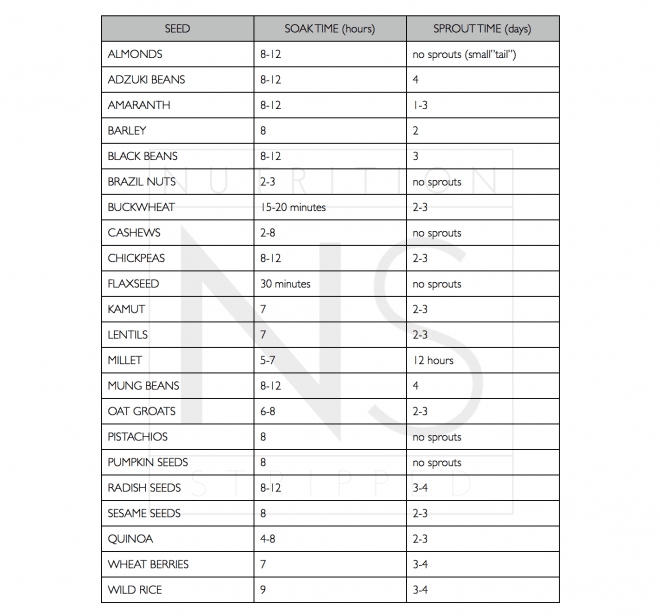
STEP 2, WAIT // Let the nut/seed/grain/legume soak for the given time. I will leave a link to a sprouting chart that will tell you how long to soak. (http://nutritionstripped.com/wp-content/uploads/2014/03/Screen-Shot-2014-03-24-at-2.39.19-PM-e1395690006116.png) Soaking and sprouting times differ amongst each grain, seed, nut, or legume. Note in the chart that soaking times take about 8-12 hours and sprouting times take 2-4 days so try to plan accordingly.
STEP 3, RINSE // Follow the soaking process with thorough rinsing. Rinse the water until it becomes clear, pour the old water out, fill with new clean water and repeat until clear. If you’re using a sprouting jar this is incredibly easy because you just pour water through the mesh lid and rinse as well- no needed to use a strainer. If you’re using a strainer simply rinse water on top and pay close attention for the water to become clear.
The process can stop here for most nuts/seeds and grains as they can be used just soaked and not sprouted. For example, making your own nut milks from the soaked nuts/seeds is perfect. Also, if you want to cook immediately your soaked grains and legumes, you can do so. Another option is to continue to STEP 4 and sprout them, dehydrate, and then enjoy.
STEP 4, SPROUT // Refer to the sprouting chart for the times on how long it will take each nut/seed/grain/legume to sprout as they all differ. Essentially what you will be doing for this sprouting time is rinsing with filtered water several times/day- think of it as “watering” a plant (do this at least twice/day). The goal is to rinse the nut/seed/grain/legume and drain the rest of the water off (I do this by putting my sprouting jar upside down at about a 45 degree angle in my kitchen dish drying rack, it’s perfect because all the excess water goes right down the sink and gives the seeds enough air circulation to grow!
STEP 5, GROW // As the nut/seed/grain/legume starts to sprout, you’ll notice tiny “tail” coming from the seed, this mean it’s growing and sprouting! Sprouting times can vary from 1-4 days, you’ll know it’s finished when the seeds have a tail or they’ve sprouted greens!
STEP 6, STORE // Keep sprouts fresh in the fridge by wrapping them in a mesh cheesecloth and use within 3-4 days. You have to be strict about eating them for only 3-4 days and keeping them refrigerated because sprouts are at risk for contamination with food illnesses and bacteria such as E. coli. This can simply be avoided by keeping your kitchen clean, jars cleaned, hands washed, and purchasing organic seeds/nuts/grains/legumes. I’ve been sprouting almost weekly for the past 8 years and I’ve never had an issue.
Besides testing wheat versus gluten versus sprouted grains when it comes to carbs we also test white rice versus brown rice. Brown rice is known to be healthier and people voluntarily eat brown rice thinking they are making the healthier choice but what if they aren’t? It is true, brown rice has more fiber and nutrients than white rice but sometimes the fiber doesn’t do well with people who have an inflamed gut. The fiber can be scratchy to the intestinal wall irritating the inflamed gut. The second reason why someone would test negatively for brown rice is that the brown rice plant has the ability to absorb arsenic from the soil. Arsenic is not normally found in soil but if the soil is contaminated it will absorb it. Believe it or not arsenic is found in conventionally raised poultry because it is in commercial chicken feed. It is also in wine, treated wood, pesticides, insecticides, paints, table salt, and tobacco smoke.
Obviously arsenic poisoning is just a way of life that no one told you about. A healthy body arsenic in, body will detox it and arsenic out but those who are sensitive to it need to stay away for some time until we can get the body healthier and able to detox on it’s own. Just a quick sidetone, kale will absorb thallium from contaminated soil just like brown rice absorbs arsenic. Kale is a superfood that people are eating like crazy to be healthy but if your detox pathways aren’t open and you can’t handle the thallium then you need to be careful. That’s the beauty of muscle testing, knowing exactly what foods are healthy for you.
To learn more about detoxing heavy metals, listening to this podcast: https://healingarts.buzzsprout.com/894679/3022864-heavy-metal-detox
Now white rice has very little nutritional value and can spike up the blood sugar easily. Eating sprouted rice is healthier and it does not absorb arsenic or have fiber that can be irritating so it can be a very neutral food for people. Neutral meaning it does not harm nor has much nutritional value and can be an easy carb to eat when avoiding gluten/wheat.
Oats is another carb that people think is healthy and is known specifically to be heart healthy but there are so many people that have to take a break from their daily oatmeal after being muscle tested precisely because they are having it daily. Foods need to be rotated for optimal health. The body cannot eat the same thing over and over again. It puts too much stress on the digestive system. The body needs variety. It needs the different nutrients from different foods. My rule of thumb is to rotate foods every four days. So you will need three different breakfasts.
Speaking of breakfast, one of the other things we test for are organic eggs versus common egg versus egg white versus egg yolk. We want to be very specific about what type of egg you can eat if any. If so, you may think that buying organic eggs is the best you can do… but there’s more! Organic eggs are really just a single step up from regular eggs.
If you see the word “organic” on a label, including eggs, you might think that the hens who laid the eggs lived in better conditions and enjoyed happier lives than their battery cage friends, but even certified organic eggs can come from birds who are subject to living in inhumane factory conditions.
Most industrial egg-laying operations get by following the minimum standards required. They are allowed to do this by simply including a small porch area attached to a two-story building where their chickens are housed, and they can call this “outdoor access.”
Certified organic eggs come from hens that are raised on hormone-free and antibiotic-free organic feed full of corn and soy, and have “access” to outdoor areas. But with those living conditions the chickens are not at their healthiest to produce the healthiest eggs.
If you can’t even trust a certified organic label for eggs, which eggs can you buy? Here are some other terms used to label the various conditions under which eggs are produced and what they mean:
Cage-free: This is a loose, unregulated term describing eggs which could be from hens confined to a barn, OR from chickens with access to outdoor space. There is no specific regulation for the term cage-free and there is a big difference between these options! Cage-free egg producers are not audited by independent inspectors, unless they are also certified organic.
Many people buy cage-free eggs thinking that these hens have access to outdoor pasture, but the truth is that they usually live inside dark enclosed sheds. The chickens are free to roam around within the confined space and to stretch and spread their wings, which is a significant improvement over cage conditions, but they still don’t typically have free roaming access to outdoor pasture.
Free-range: Even though it sounds good, “free-range” doesn’t mean pasture-raised any more than “cage free” does. Free-range hens, you would think, should have access to the outside, but again, there is no regulation that guarantees how long they need to be outside, how much room they are given, or any other standards that would make them “free-range.”
Free-range hens can still be fed GMO feed, given antibiotics, and other animal by-products. They often live in overcrowded conditions, and they may or may not have access to more comfortable nests and perches.
Omega-3 Enhanced: Omega-3 enhanced eggs come from chickens that consume significant amounts of flax, which contains high levels of omega-3 fatty acids. Most omega-3 enhanced egg laying hens in battery cages. The amounts of omega-3 fatty acids in these eggs is unregulated and can be quite variable.
Pasture-raised: Authentic free-range eggs come from hens raised on grassy pastures. These eggs are visibly more nutritious than eggs obtained from cage-free, or confined environments. Free-range producers are not audited by third parties unless the eggs are also certified organic so make sure you talk to your supplier about the eggs, but pasture-raised would be your best bet for the best eggs ever.
The color, flavor and texture of a pasture-raised egg is distinctively noticeable, and due to high amounts of Vitamin A, D, E, K2, B-12, folate, riboflavin, calcium, zinc, beta carotene, choline, and loads of omega 3 fatty acids, a pasture-raised egg is a true superfood. If you’ve never eaten an egg from a hen raised on sunshine, bugs and grass, then you are in for a treat!
Note that some eggs are labelled “pasteurized” and this means something different from pastured. Pasteurized eggs have been treated to eliminate bacteria such as salmonella so they can be eaten raw.
If you are not sure how the eggs you buy rate, use the Organic Egg Brand Scorecard link to learn more about the source of eggs available to you and to help you choose a healthier, and more humanely raised egg!
Another food we test for is corn. Corn sounds easy to stay away from. If I tell people to stay away from corn they think, “that’s fine, no corn on the cob, corn chips or corn flakes.’ But it also includes corn oil, popcorn, high fructose corn syrup and some people are so sensitive to it that they have to make sure that the eggs and meat they are eating are not from animals eating corn but are instead pasture raised or grass fed. Without those labels you can assume the animals are eating tons of corn, soy and antibiotics. Corn and soy are extremely cheap to produce and America produces a lot of them so the food companies find new ways to incorporate them into our foods. That’s where high fructose corn syrup comes from. Do you think we need another processed sweetener in our food? No, but the FDA found a cheaper version than cane sugar and beet sugar when it made high fructose corn syrup. If you are allowed to eat corn it is very important to only eat organic. Otherwise the corn you are eating is genetically modified and ladened with pesticides.
We muscle test for soy as well. A lot of studies have been done about the ill effects of soy (http://www.westonaprice.org/wp-content/uploads/FDASoyReferences.pdf). Soy contains something in it that acts like estrogen in our body. We call it phytoestrogen. Phyto means plant and when something acts like estrogen in our bodies it really does disturb our hormone pathways. Animals eating a lot of soy and being given hormones is the main reason why I think girls reach puberty and get their periods at a younger and younger age each generation. Science also shows phytoestrogens have the potential to cause infertility and to promote breast cancer in adult women. Soy phytoestrogens are known to harm the thyroid too and cause hypothyroidism and may even cause thyroid cancer. In infants, consumption of soy formula has been linked to autoimmune thyroid disease.
Soy, like beans, have high levels of phytic acid which reduces assimilation of calcium, magnesium, copper, iron and zinc. Phytic acid in soy is not neutralized by ordinary preparation methods such as soaking, sprouting and long, slow cooking. Vitamin B12 in soy is not absorbed and actually increases the body’s requirement for B12. Soy also increases the body’s requirement for vitamin D. So instead of being nutritious, soy depletes our body of nutrition.
When asking patients to stay away from soy, besides avoiding edamame, tofu, and soy sauce eating only good quality pasture raised meat and eggs are in order otherwise the animals eat a lot of soy. Also read food labels to look for hidden sources of soy. Soy is hidden in so many foods as soybean oil, soy lecithin and MSG. Monosodium glutamate or MSG, is a extreme neurotoxin, and is formed during soy food processing and additional amounts are added to many soy foods.
When it comes to drinking milk, specifically cow milk, there is a lot of controversy. Is it good for us? Don't we need the calcium from it? Is whole milk really the best with a higher concentration of fat? The questions can go on and on.
So let's take it step by step. Is cow milk healthy for us? My answer, which is my answer for everything, is it depends on how you muscle test for it. So to all my patients who do test well for milk the best cow milk to drink is A2 milk. A2 milk is cow's milk that mostly lacks a form of β-casein proteins called A1 and instead has mostly the A2 form. Beta-casein makes up about 30 percent of the protein in cow's milk. A1 and A2 are two variants of beta-casein. Historically, cows produced milk that contained only the A2 form of beta-casein. So the genetic change that makes A1 protein is harder for us to digest.
The percentage of the A1 and A2 beta-casein protein varies between herds of cattle, and also between countries. While African and Asian cattle continue to produce only A2 beta-casein, the A1 version of the protein is common among cattle in the western world. Goat, sheep, water buffalo and human breast milks all contain only A2-like proteins, and thousands of years ago, cow’s milk also had only A2.
During the breakdown of A1 in the gut, a peptide fragment (a chain of amino acids) called BCM-7 is formed. This fragment can slow down digestion, trigger inflammation and cause symptoms such as bloating, gas, abdominal pain, diarrhea and constipation (http://www.mdpi.com/2072-6643/7/9/5339/htm). No such fragment is formed with A2 digestion. If those symptoms sound similar to those of lactose intolerance, it’s because they are. And many people may be misdiagnosing themselves when it is really A1 they need to avoid.
Milk that contains only A2 milk was brought to market by The a2 Milk Company from New Zealand in 2000 and is sold mostly in Australia, New Zealand, China, United States and the United Kingdom. I just recently found it at a local grocery store called Shop Rite. A genetic test, developed by the a2 Milk Company, determines whether a cow produces A2 or A1 type protein in its milk. The test allows the company to certify milk producers as producing A2 milk.
Whole fat A2 milk is the best type to drink because the extra fat content is how Mother Nature made it so your body can digest it better. Research even shows that among adult women, higher intake of high-fat dairy was actually linked to less weight gain than intake of low-fat dairy (https://pubmed.ncbi.nlm.nih.gov/26912496/). And a recent study of children ages 1-6 years old found that those who drank whole milk had higher vitamin D levels and lower BMI (body mass index) than those who drank low-fat fat (https://academic.oup.com/ajcn/article/104/6/1657/4668588).
For those of you who don't drink milk but have read this and now are worried about not getting enough calcium in your diet here are other calcium sources: http://healingartsnyc.blogspot.com/2018/06/got-milk-if-not-try-these-other-calcium.html.
Besides milk we also test for cheese in a separate vial. Due to the fermentation process sometimes people will test fine for cheese but not for milk. Other times it’s the other way around and because of the mold during the fermentation process someone will test negatively for cheese and okay for milk. Butter is also a dairy product but tends to be fine for more people because it has barely any lactose or casein in it which are the two main culprits of why someone would react poorly to milk and cheese. Again, to know for sure if butter is okay for your body, it is best to get muscle tested.
Fruit can be a sensitivity that some people have to stay away from because the fruit sugar also known as fructose is stress full on the body, especially the liver. Even when people test fine for fruit sometimes I limit the fruit to only one serving a day. There is a lot of vitamins and minerals in fruit but the fruit sugar can cause stress on the body. Also with genetic modifications and our soil being depleted of minerals an apple today contains more fructose and less minerals than 50 years ago. A good book on this topic is Empty Harvest by Dr. Bernard Jensen. Our food unfortunately isn't as nutritious as it used to be.
Depending on the person’s muscle testing sometimes fruit has to be limited even more to only berries, limes and lemons because the sugar content of those fruits is less than other fruits. Other times, the muscle testing shows that a person cannot handle any fruit at all. If the person is really going through a blood sugar situation or an adrenal fatigue phase we have to stay away from fruit because even fructose can cause an increase in blood sugar. Even a small spike in blood sugar can elicit a hormonal reaction from the adrenal glands that sometimes the body cannot handle.
I do look at tomatoes as a fruit that gets muscle tested separately because tomatoes are also a night shade. Night shades are a group of foods that can cause chronic pain due to the inflammation that they cause. Besides tomatoes night shades also include peppers, potatoes, eggplant, and goji berries.
The other thing about tomatoes is the lectins. Lectins are microscopic proteins that plants evolved to defend themselves from predators, including insects and animals (that includes humans!). They are essentially indigestible and have the unique ability to increase the permeability of your intestines which eventually can cause a leaky gut or more intense situations.
That means that lectins and other small particles of food can pass through the wall of your gut, and will be treated as foreign invaders by your immune system. This causes an inflammatory response, which is a main reason for food sensitivities but can also set the stage for a host of diseases, as well as weight gain. If you have leaky gut until that gut is healed you will have food sensitivities.
Dr. Steven Gundry popularized the lectin-free diet. He is a former heart surgeon who switched his focus to food and supplement-based medicine. Dr. Gundry describes lectins as the main danger found in the American diet. In response, he has written a book that provides information on how to avoid lectins, alternative food choices, and recipes, The Plant Paradox.
According to the book when lectins are harmful, leaking through the gut and causing inflammation, the auto-immune diseases that can be created are celiac disease, diabetes, and rheumatoid arthritis, heart disease, cancer, and depression.
Following a lectin-free diet could be a way to lower inflammation in the body. The best way to know if avoiding lectins would make a difference in your health is to get muscle tested to see how your body responds to lectins.
According to Dr. Gundry, people should limit the following foods when trying to avoid lectins:
• legumes, such as beans, peas, soy, lentils, and peanuts
• squash
• nightshade vegetables, such as eggplant, peppers, potatoes, and tomatoes
• fruit, although in-season fruit is allowed in moderation
• all grains
• corn
• meat from corn-fed animals
• A1 milk
Soaking beans overnight in water and some baking soda, then draining them and thoroughly boiling or pressure cooking them, can eradicate nearly all lectins. In fact, pressure cooking vegetables and legumes is also an excellent way to decrease lectin content in those plant foods. But, using a pressure cooker doesn’t get rid of all lectins – it won’t even touch the lectins in wheat, oats, rye, barley, or spelt.
Likewise, sprouting grains, seeds, and beans releases enzymes that reduce lectins, and the process of fermentation can cut the lectins in dairy and vegetables.
Peel and deseed your fruits and veggies – If you’re going to use lectin-rich plant foods, make sure to peel and deseed them. Often, the most harmful part of a plant is it’s lectin-filled hull, peel, or rind. To reiterate, the peels and the seeds are often where lectins are hiding, so you can significantly cut down on your intake by eliminating that part of the plant.
Finally, if in fact you must eat grains, opt for white over brown. So, instead of brown rice, eat white rice. Instead of whole wheat bread, find a healthier version of white bread.
Turns out, though many believe brown rice is healthier than it’s white counterpart, those who eat rice as their staple grain have always stripped the hull off of brown rice before they eat it. That’s because the hull contains all the dangerous lectins.
A lectin-free diet is not easy to follow but the science is there to back up why lectins would cause inflammation in the body and lead to certain diseases. If you think it may help you and you can’t get muscle tested then try not eating lectins for 2 weeks and then add them back in and if you notice a difference then maybe avoiding lectins is the best thing you can do for your body.
Now what food blog would not be complete without talking about the health of chocolate? Over the past dozen of years or so, a steady stream of science has emerged, showing that cocoa possess extraordinary life-imbuing and disease-fighting properties, is extremely anti-inflammatory and even helps in weight loss (https://pubmed.ncbi.nlm.nih.gov/24100674/). Cocoa also demonstrates significant benefits for the cardiovascular system, helping to reduce the risk of heart attack and stroke, reduce the risk of high blood pressure, and even reduce the risk of cancer (https://www.ncbi.nlm.nih.gov/pmc/articles/PMC4696435/).
Cocoa contains over 700 known compounds. And for all we know, there may be many more that remain undiscovered. Of particular interest to scientists are the antioxidant compounds in cocoa. Antioxidants are compounds that plants manufacture to prevent their own cells from premature destruction due to exposure to heat, light, air, moisture and time. In the human body, many of these compounds prevent reactive oxygen species (ROS) from destroying cells and causing premature aging and disease. Cocoa is especially rich in polyphenols, a group of protective antioxidant compounds found in many plant foods such as red wine and tea. Yet, of all foods, cocoa has the highest antioxidant polyphenol content, and provides the greatest cardio-protection.
Cardiovascular disease is the primary killer of adults. The polyphenols in cocoa are cardio-protective in two ways. They help to reduce the oxidation of low-density lipoproteins (LDL), or so-called ‘bad cholesterol.” Oxidation of LDL is considered a major factor in the promotion of coronary disease, most notably heart attack and stroke. Additionally, polyphenols inhibit blood platelets from clumping together. This clumping process, called aggregation, leads to atherosclerosis, hardening of the arteries. By inhibiting aggregation, polyphenols reduce the risk of atherosclerosis.
Another dimension of the benefits of cocoa and chocolate consumption concerns mood. Cocoa is rich in agents that enhance the production of various feel-good chemicals in the brain, notably serotonin and dopamine. This means that cocoa possesses anti-depressant, mood-elevating properties. This may be no surprise to the millions of people who self medicate with chocolate every day and now you know why you do.
Of the mood-modifying compounds in cocoa, one is PEA, or phenethylamine. This chemical, which occurs in chocolate in small quantities, stimulates the nervous system and triggers the release of pleasurable opium-like compounds known as endorphins. It also potentiates the activity of dopamine, a neurochemical directly associated with sexual arousal and pleasure. Phenethylamine increases in the brain when we fall in love. The giddy, restless feelings that occur when we are in love are at least partly due to PEA. This adds a rather remarkable dimension to cocoa, and may account for why it is so highly prized. For while there are a great many agents in nature which boost libido and enhance sexual function, (High Libido Diet: https://healingartsnyc.blogspot.com/2015/04/the-high-libido-diet.html) chocolate alone actually promotes the brain chemistry of being in love. Chocolate is a main gift at Valentine’s Day for this very reason.
Cocoa additionally boosts a sense of well being by increasing brain levels of serotonin, the so-called feel-good brain chemical. For this reason cocoa provides a highly desirable mood boost to women during PMS and menstruation, when serotonin levels are often down. In fact, women are consistently more sensitive to cocoa than men. Women typically experience stronger cocoa cravings than men. And for many, cocoa is the perfect PMS prescription. A little cocoa can restore a feeling of well being.
The one thing that hinders chocolate from being a great super food is all the sugar we put with it. Find chocolate that is made with coconut sugar, stevia or monk fruit instead and even when it’s made with a healthier sweetener make sure you have at most only a serving a day.