Showing posts with label cholesterol. Show all posts

Sunday, February 17, 2019

Benefits of Fasting

Why You Shouldn't Eat on Mondays

Fasting is a confusing term.  If you google it there are so many studies promoting it and others that say it doesn't help.  There are also many different ways to fast and figuring out the right way can be really tough.  Depending on what your health goal is I am a fan of intermittent fasting, the type of fasting where you eat for only 8 hours a day.  It's also known as 16:8 and it depends on the person but I usually suggest an eating window to be 11am-7pm.  Read here for more on intermittent fasting (8 Things to Know Before You Try Intermittent Fasting).

I have recently been playing with the idea of taking one day a week to fast.  I have been doing a lot of research and it makes sense for some people to do.  It all depends on what your health goal is but the research shows fasting can hep people lose weight, help lower cholesterol  and lower blood pressure too. 


It works because when you’re not digesting food, your body diverts energy to a process known as autophagy. It’s essentially a means where your body recycles and ditches the junk inside of you that it doesn’t have time to address when you’re digesting food all the time. It helps to regulate hormones, improve blood sugar, and increases a couple different enzymatic processes.  Fasting also has the same impact on your growth hormones as sleep and intense exercise. Studies haven't been done on humans but various animal studies show that fasting helps extend lifespan.  

The most important thing you can do when starting a 1-day fast is to promise yourself you’ll stick with it. You will inevitably experience some discomfort during the fast, and although it’s not insurmountable, it does require some willpower to get past. Commit from the very beginning, and you’ll be going into it with the right mindset. There’s a lot of power in commitment; harness it!
A lot times when you think you’re hungry, you’re actually just thirsty. The simple way to beat this is to drink a lot of water. Water actually curbs your appetite, as it decreases one of your hormones called ghrelin, which tells your brain that you’re hungry. By drinking more water you can quiet that nagging hunger.  Water is your best friend during a 1-day fast.

The health benefits of fasting are extremely appealing, but I do want to stress that fasting isn’t always for everyone. People who suffer from hypoglycemia and diabetics should probably avoid fasting, up until blood glucose and insulin levels have been normalized. Pregnant and breastfeeding women should absolutely not fast, as it can have negative effects on the baby. So for the first time I am writing about something I actually have not tried because I don't feel like waiting a year to finish breast feeding and then fast one day a week to share my opinion.  I really wanted to give you the info now and if you think it could work for you let me know at your next appointment and I'll let you know if it's something you should consider.  


Tuesday, January 1, 2019

Are Fermented Foods the Same as Probiotics?


Are Fermented Foods the Same as Probiotics?

Consider the fundamental change from milk to brie cheese or grapes to wine. Such is the power of fermentation. Fermented foods result from the growth and metabolism of live cultures, transforming a precursor food (such as milk) into a fermented food (cheese). The fermentation process may result in changes in taste, texture, aroma, nutritional value, microbial content and perhaps health benefits that extend beyond the basic nutritional value of the food. Because of this last property, some call fermented foods ‘probiotics’, but in fact they are not (necessarily) the same.

Wine, brie and grapes

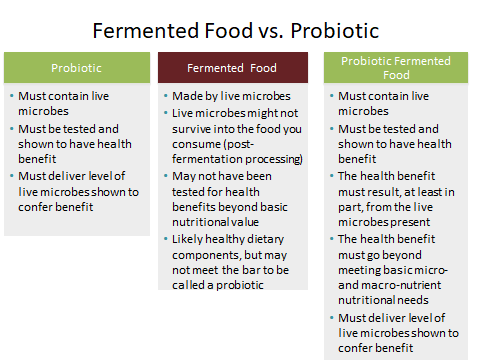
Probiotics are live microorganisms that, when administered in adequate amounts, confer a health benefit on the host. Unlike fermented foods, probiotics must have been tested in human studies and shown to have a beneficial health effect. Fermented foods don’t require such testing, although some have been. Further, some fermented foods are treated after they are made (for example, sourdough bread is baked), and do not contain live microbes at the point of consumption. To the extent a fermented food has been tested in human studies and shown to be beneficial and delivers a sufficient ‘dose’ of beneficial live microbes, it meets the bar of a probiotic. (See figure below). This is the case with several probiotic yogurts and fermented milks on the market today.
You likely have seen publicity and testimonials about how good for you fermented foods such as kombucha or sauerkraut are. Many of these foods may be good for your gut or immune system, but not as good as probiotics. If you enjoy them and they make you feel better, they are great additions to your diet. Scientists are now speculating that any source of live microbes may turn out to be beneficial.  To learn more about the benefits of probiotics read this review.
The body of evidence substantiating benefits of probiotics is quite extensive. Over 1800 human trials have been conducted using probiotics. See table below for a list of some benefits of probiotics shown in human trials. Keep in mind that benefits are tied to specific strains. It’s easy to grasp this concept if you look to the animal world. Different breeds of horses, for example, have quite different strengths and functions. You wouldn’t ride a pony in the Kentucky Derby.  Similarly, different strains of even the same species of a probiotic may have different benefits. In some cases, more than one independently tested probiotic product confers the same benefit. In other cases, only a single probiotic product has been shown to be effective. The best evidence for probiotic use is for prevention of antibiotic-associated diarrhea and C. difficile infection, management of certain gut symptoms, and prevention of necrotizing enterocolitis in preemie infants. People often wonder if probiotics have any benefit for healthy people. Benefits such as improved tolerance of dietary lactose for lactose intolerant people, management of blood lipids, improved oral health, reduced incidence of common infectious diseases such as the common cold, and management of gut symptoms all are demonstrated in reasonably healthy people.
The probiotic marketplace can be confusing for consumers. If you aren't being muscle tested for what probiotic your body needs here are some basic principles to guide your search:
  • There is no one strain or one dose that is best. Sometimes lower dose products or products with fewer strains have the best evidence.
  • One of the biggest challenges in the probiotic market is keeping the probiotic strain alive. Responsible manufactures go to great lengths to be sure their probiotics retain viability and deliver an efficacious dose through the end of the product’s shelf life. Unfortunately, not all products on the market are responsibly formulated. Consumers should buy products from companies they trust like I trust Standard Process

BenefitPopulation
Treat colic in breastfed infantsInfants
Prevent atopic dermatitis/food hypersensitivityInfants
Prevent necrotizing enterocolitisPremature infants
Treat acute diarrheaInfants, children
Manage symptoms of occasional constipationAdults
Manage symptoms of lactose intoleranceChildren, adults
Reduce incidence and duration of common infectious diseases (upper respiratory tract and gastrointestinal)Children, adults
Prevent antibiotic-associated diarrheaChildren, adults
Extend remission of ulcerative colitisAdults
Improve therapeutic efficacy of antibiotic treatment of bacterial vaginosisAdult women
Reduce low density lipid cholesterolAdults
Prevent Clostridium difficile diarrheaChildren, adults
Reduced prevalence of dental caries and gingivitisInfants, children

Friday, May 11, 2018

Health Benefits of

Diatomaceous Earth

Food grade diatomaceous earth (DE) is a white powder that is almost entirely made of silica.  Silica is a mineral that is already in our body and is an important component of our  ligaments, cartilage, and muscles. When taken as a supplement DE may help to absorb mercury, E. coli, parasites, viruses, pesticide, radiation, drug residues and other toxins.

The only cautionary side effect that we have found relating to food grade diatomaceous earth has to do with direct inhalation and is essentially the same caution that is advised when handling any fine powder. Diatomaceous Earth is a very fine powder. 

Food Grade Diatomaceous Earth is 89% Silica.  It was established in the 1940s that life can’t exist without Silica. More recently, in her book “Water & Salt” Dr. Barbara Hendel states: “Silica is the most important trace element in human health.” Silica plays an important role in many bodily functions and has a direct relationship to mineral absorption.

Yet most people are, in fact, silica deficient.  We carry around 90mcgs of silica per 1 gram of hair we have on our bodies and we carry around 100mcgs of silica per 1 gram of bone.  Silica is in all of our connective tissue and it is so very important to include this mineral in our diets. Silica is mostly found in the fiber portions of whole grains, and the skins of fruits and vegetables.

Among other things, enough silica in the body is vital for calcium absorption to allow calcium supplements to work.

Reported Health Benefits of Silica / Diatomaceous Earth Include:

  1. Maintaining Healthy Blood Pressure Levels
  2. Maintaining Healthy Cholesterol Levels
  3. Better Calcium Utilization for help with Osteoporosis and Healthier Joints
  4. Stimulates Weight Loss
  5. Improvement in Hair, Nails, Teeth & Gums
  6. More Energy


According to Kayla T. Daniel, PhD, CCN and Galen D. Knight, PhD in their article “Mad as a Hatter” there is no better product to detox heavy metals and radiation from your body than with Food Grade Diatomaceous Earth!

Take diatomaceous earth daily on an empty stomach. I recommend starting small and slowly working your way up to a higher dose; begin with a teaspoon added to at least 12 ounces of liquid. Mix vigorously and drink immediately.  Some people don't like the mildly chalky flavor and gritty texture. If that describes you, try adding DE to a drink with more flavor (milk, orange juice, coffee, smoothies) or to light foods like yogurt, oatmeal, or applesauce.

As your body begins to detox, you may experience what is commonly known as "die off," which sometimes gives people mild flu-like symptoms for a couple days. This is a side effect of toxins leaving your body, not a side effect of DE itself. You can counteract these symptoms by increasing your fluid consumption, as well as reducing your DE dose for a couple days.

For gum health, because DE is one of the most nourishing substances for your gums, as your gums are connective tissue, which needs silica. To use it, mix 1 heaping tablespoon with water into a paste consistency. Pack it into your gums overnight after you brushed your teeth. Your gums will absorb the diatomaceous earth.  

If you have other ideas on how to use DE please share!

Sunday, March 11, 2018

6 Reasons to Drink Kombucha Daily 
Kombucha is a beverage with tremendous health benefits extending to your heart, your brain and especially your gut. How does this drink make such a huge difference in your body?
Due to the fermentation process involved in creating kombucha, it contains a large number of healthy bacteria known as probiotics. On more about how fermented foods help gut health, read here.  These bacteria live in your digestive tract and support your immune system by absorbing nutrients and fighting infection and illness.

Since 80% of your immune system is located in your gut, not only will drinking kombucha help the immune system but it also helps the brain.  The majority of neurotransmitters that you need for good brain chemistry is made in the gut so to have a healthy brain, feel good and think well, you need a healthy gut.  It’s no surprise that the gut is considered the “second brain.” Drinking kombucha every day can help you to maintain peak immune, gut and brain health.

Kombucha is a fermented beverage consisting of black tea and sugar (from various sources, including cane sugar, fruit or honey) that’s used as a functional, probiotic food. It contains good bacteria and yeast that are responsible for initiating the fermentation process once combined with sugar. Patients ask me if they can drink kombucha even though they I told them to stay away from sugar and the answer is yes!  It is because the sugar that is used in making kombucha is eaten by the bacteria so by the time we drink it the sugar is in the bacteria and not too much is free-floating in the drink.  That is why when you look at the ingredient list most of the time sugar is not an ingredient.  There is none left after the fermentation process is complete.  

After fermentation, not only is the sugar gone but kombucha becomes carbonated and contains vinegar, B vitamins, enzymes, probiotics and a high concentration of acid (acetic, gluconic and lactic acids). The sugar-tea solution is fermented by bacteria and yeast commonly known as a “SCOBY” (symbiotic colony of bacteria and yeast). Although it’s usually made with black tea, kombucha can also be made with green teas. Contrary to common claims, a SCOBY is not a kombucha mushroom.
If you are interested in kombucha, it’s generally available for $3-5 at natural health food stores and some grocery stores. Others make it at home (which I’ll discuss a little later on).
Some people find it a healthier substitute for sodas, satisfying that craving for a fizzy drink.

The following probiotic strains make up this health elixir: 

  • Gluconacetobacter (>85 percent in most samples)
  • Acetobacter (<2 percent)
  • Lactobacillus (up to 30 percent in some samples)
  • Zygosaccharomyces (>95 percent)
There is some debate about the benefits of unpasteurized kombucha because of the 20th/21st century notion that pasteurization makes drinks “healthier.”  It’s not true for milk and the same holds for kombucha. The bacteria killed during the pasteurization process is the same stuff that can help your gut function more efficiently. “Pasteurized kombucha” should probably be called “kombucha-flavored tea” because the benefits of healthy bacteria have been lost during that process. The healthy benefits of the good bacteria are no longer there.  

One consideration is that pasteurized kombucha is not continually fermented. This means that if a commercial unpasteurized kombucha product is left on the shelf too long, the alcohol content (initially below .5 percent for most products) may rise somewhat. Be sure to purchase your kombucha from trustworthy sources and drink it within a relatively brief time after purchasing. If you make kombucha at home, the same rule applies.

6 Benefits of Kombucha

1. Helps prevent a wide variety of diseases
Kombucha contains powerful antioxidants and can help to detoxify the body and protect against disease. Related to this disease-fighting power is the way these antioxidants help to reduce inflammation. This inflammation-reducing, detoxing quality is probably one reason kombucha might potentially decrease the risk of diseases.  One reason this happens is because antioxidants reduce oxidative stress that can damage cells, even down to DNA. Being exposed to a lot of processed foods and chemicals within your environment can lead to this stress, which in turn contributes to chronic inflammation. While normal black tea does contain antioxidants, research shows that the fermentation process of kombucha creates more antioxidants not present in black tea. Kombucha may specifically influence the activity of two important antioxidants known as glutathione peroxidase and catalase. It was also discovered to contain a metabolite of quercetin.  Quercetin is associated with a long lifespan and massive anticancer properties. Research from the University of Latvia in 2014 claims that drinking kombucha tea can be beneficial for many infections and diseases “due to four main properties: detoxification, anti-oxidation, energizing potencies and promotion of depressed immunity.” (https://www.ncbi.nlm.nih.gov/pubmed/24192111)

2. Supports a healthy gut

These antioxidants also help the gut but kombucha supports digestion also because of its high levels of beneficial acid, probiotics, amino acids and enzymes.
Some research has shown kombucha’s ability to prevent and heal stomach ulcers in mice which could be the same in humans too. (https://www.ncbi.nlm.nih.gov/pubmed/21776478)
Kombucha can also help heal Candida from overpopulating within the gut by restoring balance to the digestive system.  With enough good bacteria in the system Candida cannot grow.  
Candida and other digestive problems can sometimes be complicated issues to fix, and symptoms might actually get worse before getting better. If you feel like kombucha is exacerbating the problem, consider that gut problems aren’t always a straight path to healing and at times some patience or trial and error is needed. You can always bring kombucha in to your next appointment to get it muscle tested

3. May help improve mental state
Kombucha doesn’t just help your digestion; it might be able to protect your mind, too. One way it can accomplish this is by the B vitamins it contains. B vitamins, particularly vitamin B12, are known to increase energy levels and contribute to overall mental wellbeing.
The gut-repairing function of kombucha also plays a role in mental health. Depression may be a major symptom of leaky gut, specifically due to the way that bad gut permeability contributes to inflammation.  A 2012 study published in Biopolymers and Cell examined kombucha as a functional food product for long-term space exploration (yes, you read that right). They drink it in order to prevent or minimize the effects of anxiety and depression.  The study was done on astronauts but if it works for them it would work for us Earth people too.

4. Powerful antibacterial agent

This one seems a little counterintuitive, doesn’t it? But it’s true – because of the type of bacteria found in kombucha, drinking the live cultures actually destroys bad bacteria responsible for infections. In lab studies, kombucha has been found to have antibacterial effects against staph, E. coli, Sh. sonnei, two strains of salmonella and Campylobacter jejuni. 

The last of those, C. jejuni, is probably the most common cause of food poisoning in the US. It can sometimes be followed by a condition called Guillian-Barré syndrome, where the immune system attacks the nervous system. Because of the immense dangers of foodborne infections and significant costs to treat, the FDA is very interested in potential treatment methods for C. jejuni.

5. Helpful in managing diabetes

Although some practitioners warn against kombucha for diabetics, it seems that some research suggests just the opposite. This is assuming, of course, that you are consuming kombucha without a high sugar load.
Particularly due to the functions of antioxidants in kombucha, it seems to help alleviate diabetes symptoms. This appears to be especially true in terms of liver and kidney functions, which are generally poor for those with diabetes. 

6. Good for the cardiovascular system

Kombucha has been considered to be beneficial to the heart for some time, although research efforts in this area have been scarce. However, it seems clear that, in animal models, kombucha helps to lower triglyceride levels, as well as regulate cholesterol naturally. (https://www.ncbi.nlm.nih.gov/pubmed/25856715)


Sunday, September 7, 2014

Miracles of Coconut Oil

Over the last year there has been a surge of new coconut products - coconut sugar, coconut butter, coconut water, etc. I highly recommend these products to my patients as healthy alternatives to white refined sugar, margarine or fruit juices. A few weeks ago I blogged about the benefits of oil pulling and after sesame seed oil the next best oil to use is coconut oil and I wanted to take the time now to talk more about how much one can benefit from adding more coconut oil into their diet.

The health benefits of coconut oil include hair care, skin care, stress relief, cholesterol level maintenance, weight loss, boosted immune system, proper digestion and regulated metabolism. It also provides relief from kidney problems, heart diseases, high blood pressure, diabetes, HIV, and cancer, while helping to improve dental quality and bone strength. These benefits of oil can be attributed to the presence of lauric acid, capric acid and caprylic acid, and their respective properties, such as antimicrobial, antioxidant, anti-fungal, antibacterial and soothing qualities.

Hair care:
Coconut oil is one of the best natural nutrients for your hair. It helps in healthy growth of hair and gives your hair a shiny quality. It also provides the essential proteins required for nourishing and healing damaged hair. By regularly massaging your head with coconut oil, you can ensure that your scalp is free of dandruff, even if your scalp is chronically dry. It also helps in keeping your hair and scalp free from lice and lice eggs.

Heart diseases:
There is a misconception spread among many people that coconut oil is not good for heart health. This is because it contains a large quantity of saturated fats. In reality, coconut oil is beneficial for the heart. It contains about 50% lauric acid, which helps in actively preventing various heart problems like high cholesterol levels and high blood pressure. The saturated fats present in coconut oil are not harmful as you commonly find in vegetable oils. Coconut oil does not lead to increase in LDL levels, and it reduces the incidence of injury and damage to arteries and therefore helps in preventing atherosclerosis.

Digestion:
A tablespoon taken before each meal can help improve digestion. It can also be taken in warm ginger tea to sooth heartburn or nausea.

Skin care:
Coconut oil is an excellent massage oil for the skin. It acts as an effective moisturizer on all types of skin and has a natural SPF 4. It also delays the appearance of wrinkles and sagging of skin which normally accompany aging. It makes for a great after-shave lotion. Coconut oil also helps in treating various skin problems including psoriasis, dermatitis, eczema and other skin infections. It can relieve the pain of hemorrhoids when used topically. When put on cuticles it helps nails grow and also makes a great eye-makeup remover!

Weight loss:
Coconut oil is very useful for weight loss. It contains short and medium-chain fatty acids that help in taking off excessive weight. It is also easy to digest and it helps in healthy functioning of the thyroid and endocrine system. Further, it increases the body’s metabolic rate by removing stress on the pancreas, thereby burning more energy and helping obese and overweight people lose the weight.

Immunity:
Coconut oil is also good for the immune system. It strengthens the immune system because it contains antimicrobial lipids, lauric acid, capric acid and caprylic acid which have antifungal, antibacterial and antiviral properties. A tablespoon melted into a cup of warm tea can help sooth a sore throat.

Candida:
Coconut oil has been shown to prevent and even cure candida. It provides relief from the inflammation caused by candida, both externally and internally. Its high moisture retaining capacity keeps the skin from cracking or peeling off. Further, unlike other pharmaceutical treatments for candida, the effects of coconut oil is gradual and not drastic or sudden, which gives the body an appropriate amount of time to slowly kill the fungi and prevent adverse symptoms that can occur when killing the fungi too fast. Adverse symptoms of treating candida to aggressively is known as a die-off reaction. But, in the treatment of this condition, people should systematically and gradually increase their internal dosages of coconut oil and shouldn’t initially start with a large quantity. When having a yeast infection you can soak a tampon in coconut oil and insert it overnight for topic treatment.

Purpose————–Preferable Type to Buy

Cooking————–Refined Coconut Oil

Weight Loss———Virgin Coconut Oil

As a Carrier Oil—–Virgin Coconut Oil

Good Health———Virgin Coconut Oil, Organic Coconut Oil

Massaging———–Pure Coconut Oil, Refined Coconut Oil

Hair——————–Pure Coconut Oil, Refined Coconut Oil

Medicinal uses—–Virgin Coconut Oil, Virgin Organic Coconut Oil

For more information read "The Coconut Oil Miracle" by Bruce Fife