Showing posts with label fermented food. Show all posts

Tuesday, January 1, 2019

Are Fermented Foods the Same as Probiotics?


Are Fermented Foods the Same as Probiotics?

Consider the fundamental change from milk to brie cheese or grapes to wine. Such is the power of fermentation. Fermented foods result from the growth and metabolism of live cultures, transforming a precursor food (such as milk) into a fermented food (cheese). The fermentation process may result in changes in taste, texture, aroma, nutritional value, microbial content and perhaps health benefits that extend beyond the basic nutritional value of the food. Because of this last property, some call fermented foods ‘probiotics’, but in fact they are not (necessarily) the same.

Wine, brie and grapes

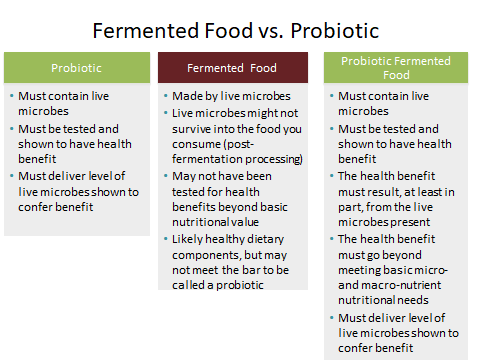
Probiotics are live microorganisms that, when administered in adequate amounts, confer a health benefit on the host. Unlike fermented foods, probiotics must have been tested in human studies and shown to have a beneficial health effect. Fermented foods don’t require such testing, although some have been. Further, some fermented foods are treated after they are made (for example, sourdough bread is baked), and do not contain live microbes at the point of consumption. To the extent a fermented food has been tested in human studies and shown to be beneficial and delivers a sufficient ‘dose’ of beneficial live microbes, it meets the bar of a probiotic. (See figure below). This is the case with several probiotic yogurts and fermented milks on the market today.
You likely have seen publicity and testimonials about how good for you fermented foods such as kombucha or sauerkraut are. Many of these foods may be good for your gut or immune system, but not as good as probiotics. If you enjoy them and they make you feel better, they are great additions to your diet. Scientists are now speculating that any source of live microbes may turn out to be beneficial.  To learn more about the benefits of probiotics read this review.
The body of evidence substantiating benefits of probiotics is quite extensive. Over 1800 human trials have been conducted using probiotics. See table below for a list of some benefits of probiotics shown in human trials. Keep in mind that benefits are tied to specific strains. It’s easy to grasp this concept if you look to the animal world. Different breeds of horses, for example, have quite different strengths and functions. You wouldn’t ride a pony in the Kentucky Derby.  Similarly, different strains of even the same species of a probiotic may have different benefits. In some cases, more than one independently tested probiotic product confers the same benefit. In other cases, only a single probiotic product has been shown to be effective. The best evidence for probiotic use is for prevention of antibiotic-associated diarrhea and C. difficile infection, management of certain gut symptoms, and prevention of necrotizing enterocolitis in preemie infants. People often wonder if probiotics have any benefit for healthy people. Benefits such as improved tolerance of dietary lactose for lactose intolerant people, management of blood lipids, improved oral health, reduced incidence of common infectious diseases such as the common cold, and management of gut symptoms all are demonstrated in reasonably healthy people.
The probiotic marketplace can be confusing for consumers. If you aren't being muscle tested for what probiotic your body needs here are some basic principles to guide your search:
  • There is no one strain or one dose that is best. Sometimes lower dose products or products with fewer strains have the best evidence.
  • One of the biggest challenges in the probiotic market is keeping the probiotic strain alive. Responsible manufactures go to great lengths to be sure their probiotics retain viability and deliver an efficacious dose through the end of the product’s shelf life. Unfortunately, not all products on the market are responsibly formulated. Consumers should buy products from companies they trust like I trust Standard Process. 

BenefitPopulation
Treat colic in breastfed infantsInfants
Prevent atopic dermatitis/food hypersensitivityInfants
Prevent necrotizing enterocolitisPremature infants
Treat acute diarrheaInfants, children
Manage symptoms of occasional constipationAdults
Manage symptoms of lactose intoleranceChildren, adults
Reduce incidence and duration of common infectious diseases (upper respiratory tract and gastrointestinal)Children, adults
Prevent antibiotic-associated diarrheaChildren, adults
Extend remission of ulcerative colitisAdults
Improve therapeutic efficacy of antibiotic treatment of bacterial vaginosisAdult women
Reduce low density lipid cholesterolAdults
Prevent Clostridium difficile diarrheaChildren, adults
Reduced prevalence of dental caries and gingivitisInfants, children

Sunday, March 11, 2018

6 Reasons to Drink Kombucha Daily 
Kombucha is a beverage with tremendous health benefits extending to your heart, your brain and especially your gut. How does this drink make such a huge difference in your body?
Due to the fermentation process involved in creating kombucha, it contains a large number of healthy bacteria known as probiotics. On more about how fermented foods help gut health, read here.  These bacteria live in your digestive tract and support your immune system by absorbing nutrients and fighting infection and illness.

Since 80% of your immune system is located in your gut, not only will drinking kombucha help the immune system but it also helps the brain.  The majority of neurotransmitters that you need for good brain chemistry is made in the gut so to have a healthy brain, feel good and think well, you need a healthy gut.  It’s no surprise that the gut is considered the “second brain.” Drinking kombucha every day can help you to maintain peak immune, gut and brain health.

Kombucha is a fermented beverage consisting of black tea and sugar (from various sources, including cane sugar, fruit or honey) that’s used as a functional, probiotic food. It contains good bacteria and yeast that are responsible for initiating the fermentation process once combined with sugar. Patients ask me if they can drink kombucha even though they I told them to stay away from sugar and the answer is yes!  It is because the sugar that is used in making kombucha is eaten by the bacteria so by the time we drink it the sugar is in the bacteria and not too much is free-floating in the drink.  That is why when you look at the ingredient list most of the time sugar is not an ingredient.  There is none left after the fermentation process is complete.  

After fermentation, not only is the sugar gone but kombucha becomes carbonated and contains vinegar, B vitamins, enzymes, probiotics and a high concentration of acid (acetic, gluconic and lactic acids). The sugar-tea solution is fermented by bacteria and yeast commonly known as a “SCOBY” (symbiotic colony of bacteria and yeast). Although it’s usually made with black tea, kombucha can also be made with green teas. Contrary to common claims, a SCOBY is not a kombucha mushroom.
If you are interested in kombucha, it’s generally available for $3-5 at natural health food stores and some grocery stores. Others make it at home (which I’ll discuss a little later on).
Some people find it a healthier substitute for sodas, satisfying that craving for a fizzy drink.

The following probiotic strains make up this health elixir: 

  • Gluconacetobacter (>85 percent in most samples)
  • Acetobacter (<2 percent)
  • Lactobacillus (up to 30 percent in some samples)
  • Zygosaccharomyces (>95 percent)
There is some debate about the benefits of unpasteurized kombucha because of the 20th/21st century notion that pasteurization makes drinks “healthier.”  It’s not true for milk and the same holds for kombucha. The bacteria killed during the pasteurization process is the same stuff that can help your gut function more efficiently. “Pasteurized kombucha” should probably be called “kombucha-flavored tea” because the benefits of healthy bacteria have been lost during that process. The healthy benefits of the good bacteria are no longer there.  

One consideration is that pasteurized kombucha is not continually fermented. This means that if a commercial unpasteurized kombucha product is left on the shelf too long, the alcohol content (initially below .5 percent for most products) may rise somewhat. Be sure to purchase your kombucha from trustworthy sources and drink it within a relatively brief time after purchasing. If you make kombucha at home, the same rule applies.

6 Benefits of Kombucha

1. Helps prevent a wide variety of diseases
Kombucha contains powerful antioxidants and can help to detoxify the body and protect against disease. Related to this disease-fighting power is the way these antioxidants help to reduce inflammation. This inflammation-reducing, detoxing quality is probably one reason kombucha might potentially decrease the risk of diseases.  One reason this happens is because antioxidants reduce oxidative stress that can damage cells, even down to DNA. Being exposed to a lot of processed foods and chemicals within your environment can lead to this stress, which in turn contributes to chronic inflammation. While normal black tea does contain antioxidants, research shows that the fermentation process of kombucha creates more antioxidants not present in black tea. Kombucha may specifically influence the activity of two important antioxidants known as glutathione peroxidase and catalase. It was also discovered to contain a metabolite of quercetin.  Quercetin is associated with a long lifespan and massive anticancer properties. Research from the University of Latvia in 2014 claims that drinking kombucha tea can be beneficial for many infections and diseases “due to four main properties: detoxification, anti-oxidation, energizing potencies and promotion of depressed immunity.” (https://www.ncbi.nlm.nih.gov/pubmed/24192111)

2. Supports a healthy gut

These antioxidants also help the gut but kombucha supports digestion also because of its high levels of beneficial acid, probiotics, amino acids and enzymes.
Some research has shown kombucha’s ability to prevent and heal stomach ulcers in mice which could be the same in humans too. (https://www.ncbi.nlm.nih.gov/pubmed/21776478)
Kombucha can also help heal Candida from overpopulating within the gut by restoring balance to the digestive system.  With enough good bacteria in the system Candida cannot grow.  
Candida and other digestive problems can sometimes be complicated issues to fix, and symptoms might actually get worse before getting better. If you feel like kombucha is exacerbating the problem, consider that gut problems aren’t always a straight path to healing and at times some patience or trial and error is needed. You can always bring kombucha in to your next appointment to get it muscle tested. 

3. May help improve mental state
Kombucha doesn’t just help your digestion; it might be able to protect your mind, too. One way it can accomplish this is by the B vitamins it contains. B vitamins, particularly vitamin B12, are known to increase energy levels and contribute to overall mental wellbeing.
The gut-repairing function of kombucha also plays a role in mental health. Depression may be a major symptom of leaky gut, specifically due to the way that bad gut permeability contributes to inflammation.  A 2012 study published in Biopolymers and Cell examined kombucha as a functional food product for long-term space exploration (yes, you read that right). They drink it in order to prevent or minimize the effects of anxiety and depression.  The study was done on astronauts but if it works for them it would work for us Earth people too.

4. Powerful antibacterial agent

This one seems a little counterintuitive, doesn’t it? But it’s true – because of the type of bacteria found in kombucha, drinking the live cultures actually destroys bad bacteria responsible for infections. In lab studies, kombucha has been found to have antibacterial effects against staph, E. coli, Sh. sonnei, two strains of salmonella and Campylobacter jejuni. 

The last of those, C. jejuni, is probably the most common cause of food poisoning in the US. It can sometimes be followed by a condition called Guillian-BarrĂ© syndrome, where the immune system attacks the nervous system. Because of the immense dangers of foodborne infections and significant costs to treat, the FDA is very interested in potential treatment methods for C. jejuni.

5. Helpful in managing diabetes

Although some practitioners warn against kombucha for diabetics, it seems that some research suggests just the opposite. This is assuming, of course, that you are consuming kombucha without a high sugar load.
Particularly due to the functions of antioxidants in kombucha, it seems to help alleviate diabetes symptoms. This appears to be especially true in terms of liver and kidney functions, which are generally poor for those with diabetes. 

6. Good for the cardiovascular system

Kombucha has been considered to be beneficial to the heart for some time, although research efforts in this area have been scarce. However, it seems clear that, in animal models, kombucha helps to lower triglyceride levels, as well as regulate cholesterol naturally. (https://www.ncbi.nlm.nih.gov/pubmed/25856715)


Monday, February 19, 2018

Why Good Gut Health Is Important for a Good Mood

Why Good Gut Health Is Important for a Good Mood

New research is emerging every day regarding the role of the gut and how it effects the brain.  It is now known in the medical world as 'gut-brain axis'.  The good bacteria that is in your gut are responsible to create a healthy environment so the gut can make the right neurotransmitters for the brain. This healthy bacteria is known as a microbiome that line our digestive tracts. The digestive tract itself is a center point of the nervous system, hormonal system and immune system. It is responsible for the balance of our molecules of emotion called neurotransmitters and as a result has an effect on our mood. Good gut health is known not only to help the digestion, but are key factors in obesity, hormonal balance, healthy kidney function, and much more.

How Do Probiotics Help the Brain?
Medical research is uncovering the mechanism of probiotics in mood. Probiotics is the name of supplements that contain good bacteria.  These healthy germs boost mood in two important ways: they generate a particular neurotransmitter called gamma-aminobutyric acid (GABA) and also enhance the brain receptors for GABA as well. Like a warm and gentle blanket for the brain, GABA is a calming amino acid, known to calm areas of the brain that are over active in anxiety and panic.

Animal studies working with mice showed those mice who ingested probiotics were, in general, more chilled out than the control mice.  The probiotic mice had lower levels of corticosterone in response to stress. Corticosterone is the mouse version of the human stress hormone cortisol. High levels of cortisol are common in anxiety as well as depression.  These mice were fed either the probiotic strain Lactobacillus rhamnosus or a broth without these. The lactobacillus-fed animals showed significantly fewer stress, anxiety and depression-related behaviors than those fed with just broth.

Human studies have also corroborated these mice findings. A French team learned via a double-blinded, placebo-controlled, randomized parallel group study that giving humans specific strains of Lactobacillus and Bifidobacterium for 30 days yielded beneficial psychological effects including lowered depression, less anger and hostility, anxiety, and better problem solving, compared with the placebo group. 


Yeast and the Microbiome
While a healthy microbiome will contribute to good mood, an unhealthy one full of Candida albicans (yeast), and all the toxins associated with it, may also contribute to mood disorder. Presence of yeast will alter the ability to absorb nutrients and push hypersensitivity reactions of toxin by-products which translates to inflammation in the body. Inflammation will greatly contribute to depression, anxiety and poor mental function.

What You Can Do To Keep Your Microbiome Healthy?
Steps you can take for a healthy microbiome and mood are:
1 – Avoid excess sugary foods: to avoid yeast build up. If you think you may have Candida it is best to follow a Candida diet or get foods muscle tested using Nutrition Response Testing to figure out what foods are feeding the Candida. 
2 – Good Quality Sleep: good sleep is key for the intestinal lining to repair and create a healthy microbiome.
3 – Meditation and Relaxation: Meditation and quality down time is important to keep the body in the ‘rest and digest’ mode instead of stress mode. Stress mode shuts circulation to the gut, which doesn’t allow a healthy microbiome. A good app to help you learn to meditate and relax is headspace.  
4 – Eat Foods with Fiber: Good fiber helps feed the good bacteria and keeps them healthy. Vegetables, fruits, psyllium, flax, inulin and other fibers also help keep good flora and proper balance of short chain fatty acids in the intestines. 
5 – Eat Probiotic Foods: While the French study mentioned above used a supplement, there are also many wonderful natural foods full of probiotics. These include natto (a traditional Japanese fermented food), kim chi (Korean style cabbage), sauerkraut, yogurt, kefir, tempeh, fermented milk (like buttermilk), miso, and non-baked cheeses (like aged cheese). Homemade sauerkraut is better than store bought, for the store bought stuff is pasteurized, which kills some of the good probiotics. To read more on how  fermented food heals the gut, read here. 
6 – Get tested for a probiotic supplement: A good quality probiotic should contain at least Lactobacillus and Bifidus bacteria. There are a number of good ones on the market and some that are poorly made, so it is best to get muscle tested to figure out which one you specifically need.  I have about 6 different ones in the office to cover a variety of different types of situations.  Also make sure your probiotic doesn't have any binders, fillers, milk products, or corn.  Sometimes people feel worse after taking a probiotic because the body needs to detox or kill bad gut flora first and so adding healthy gut flora to the body is overwhelming.  If that has happened to you it is best to first do cleansing program with a healthcare practitioner.  We also test to see if a prebiotic is needed along with a probiotic.  A prebiotic helps the good bacteria grow so the gut can maintain the good bacteria on it's own which is what you want in the long run.  

To learn more on what to do to have better gut health read here.  


Wednesday, November 11, 2015

Trimona Bulgarian Yogurt Is The Best!


What makes this organic cow milk yogurt different is two amazing things. The cows are grass-fed and the yogurt is not strained. Their motto, "Let the Greeks have their philosophers, leave the yogurt to us," makes me laugh every time I read it. Bulgaria is proud to have the history of producing the healthiest yogurt in Europe dating back 4,000 years ago. Russian Nobelist Ilya Mechnikov attributed yogurt as the reason why Bulgarians lived so long. He studied the yogurt and linked aging to toxic bacteria in the bowel and showed that fermented milk inhibits these germs from growing by seeding the intestine with good bacteria. Mechnikov named the yogurt microorganism Lactobacillus bulgaricus.


I'm so glad Trimona has kept the tradition of making Bulgarian yogurt and knows the importance of not only organic but grass-fed and full fat yogurt. If the fat is taken out of the yogurt so are the natural enzymes so the body doesn't know how to break down the food. All yogurt that you eat should be full-fat. It's hard to find but not impossible. If the store isn't selling Trimona then I will buy the full fat FAGE yogurt. And to tell you up front because Trimona isn't strained it has a slightly sour taste which I think is delicious!

Bulgarians know how important consuming fermented foods are for gut health and eat about 400,000 tons of their yogurt. The importance of fermented food can be found at www.westonaprice.org or my blog.

For my vegan friends try the best coconut yogurt. Anita's yogurt is a little expensive but totally worth it!